Listening to the Rain: Honouring our Indigenous Heritage from the Andes
Words: Maria Rosales
This week, the weather in Portugal changed. The sun stepped away, making space in the sky for the clouds to settle in softly, waiting. Once everything was still, the rain made its entrance quietly, almost unnoticed. It descended gently, like tiny dandelion seeds floating towards us, gathering slowly, ever so slowly, until all we could see was a layer of mist, dancing around us. The mist felt like a blanket, something we could curl up in. I embraced it with a smile, grateful for the freshness it brought down on the earth, a much-needed respite after a long summer.
The next day, the gentle blanket was ripped away from us and replaced by rain. Rain so loud it marked the passage of time that week like a drum, beating steadily in sync with the deeper, secret rhythm of the earth.
We don’t usually get much rain or mist in the south of Portugal, so when we do, I relish it. I savour its smell like a treat, because it reminds me of home.
I grew up in Mérida, a city nestled in the mountains of the Venezuelan Andes. As a child, I loved the feel of our cold, misty mornings. I remember watching from the warm comfort of our school classroom, how, during the day, clouds would cross the valley and rise, making space for the sun, like the courtesy pass of one actor to another in a play. Some days, the rain and sun would join together on stage for a special dance and grace us with a rainbow.
The weather shifts quickly in our páramos, high up in the mountains. We’ve learned to embrace this change in order to live in harmony with the rain, the sun, and the wind, adapting to their changing melody with dances and songs of our own. Through stories and myths, our ancestors taught us the importance of respect. Respect for the land, the passing storms, for our rivers, our lakes, respect for the spirits and entities that we share this space with. I understood it as respect for something previously known but now lost, forgotten; it lies buried deep down at the root of our Andean culture, like a buried treasure. What we have forgotten is like that presence mountaineers are sometimes attuned to, a special something you feel near the top of the mountain, or upon looking into the pristine waters of a hidden lake or spring.

Hendrik Sanchez (2014)
The Venezuelan anthropologist and fervent defender of our indigenous heritage, Jacqueline Clarac de Briceño, studied the legends and beliefs of the indigenous peoples of the Venezuelan and Colombian Andes. Between the Sierra Nevada of the Cocuy, in Colombia, and the Sierra Nevada of Mérida, in Venezuela, lived the indigenous communities of the Uwa or Tunebos, the Laches, the Bethuwa, the Barí, the Pedrazas, the Barianaos, the Muku, the Jamuenes, the Quinaroes, the Mukumbu, the Guazábara, among others. Although they lived far from the sea, their mythology on the origins of the world is based around the primordial existence of water and the teachings shared by the Gods, so that we could learn to control this element and preserve the harmony of our ecosystem (Clarac de Briceño 2020: 83-84).
There is an ancient indigenous story that comes to mind when I remember the childhood wonder and delight I felt whenever a rainbow appeared, it is the myth of Arco and Arca:
Arco and Arca descended from the Milky Way and gave birth to our mountain lakes. Arca became the guardian of the waters and Arco the guardian of the Páramo. On a rainy day, these guardians may reveal themselves to us in the shape of a rainbow. They may also appear in human form or as a colourful snake. Arco can only be seen by women, Arca only by men.
Like many of the spirits in our indigenous stories, Arco and Arca are neither good nor bad, they are necessary parts of the cycle of life, and there are certain aspects of them that we must be aware of and watch out for. According to popular belief, Arco lives in the water and may harm those that walk on certain puddles or swim in a lake.

Arnaldo Noguera Sifontes (2015)
As a young girl, my family would warn me to be careful around the mountain lakes we came across during our hikes. When you’ve been hiking for hours in the spicy Páramo sun and you see a lake, your first instinct is to want to touch its beautiful, emerald waters. I would walk right up to the shore and look back at my family, urging them to let me jump in. Sometimes they would shake their heads and remind me of the legend of Urao Lake, the most sacred lake in our region.
Tulio Febres Cordero, a Venezuelan writer and historian, wrote down the legend of the Urao Lake. Long before the European discovery of America, some of the first inhabitants of the Andes, the Timotes, were invaded by the Muiscas, the descendants of the Incas. It is said that the daughters of the goddess Chía, also known as Arca, survived and ran to the highest peaks of the Andes, and there they cried day and night over the ruin of their people. Their tears ran down the peaks towards the West and formed a salty lake lower down; this became the Urao Lake, known as Yohama. The daughters were eventually covered in snow and frozen; they became the white peaks of the Andes mountains, worshipped by the tribes in that area. On three separate occasions, the indigenous communities of Mucuchíes, then the Mucujún and Chama, then the Machurí, Mucujepe, and Quirorá fought against the Spanish conquistadores. Each time, the frozen daughters of Arca woke and screamed, and the lake born of their tears rose in the air like a cloud. Each time it descended further and further down the mountain.
When Yohama landed on the hot plains of Lagunillas, a secret was revealed to the indigenous community living there: there was something they could do to keep the lake from moving again, ensuring the prosperity of their land and crops in this otherwise dry region. It is said that the community living there sacrificed one child to the lake each year to placate the anger of the Timotes warriors and to trap the lake's waters. One day, the waters of the lake will be purified, and it will rise again like a cloud. Then the waters will return to the top of the Andes, where the brave Timotes came from.
Growing up, many of us were told some version of this story. We would stare down into the reddish-brown waters of the lake, wondering how much of it was true.
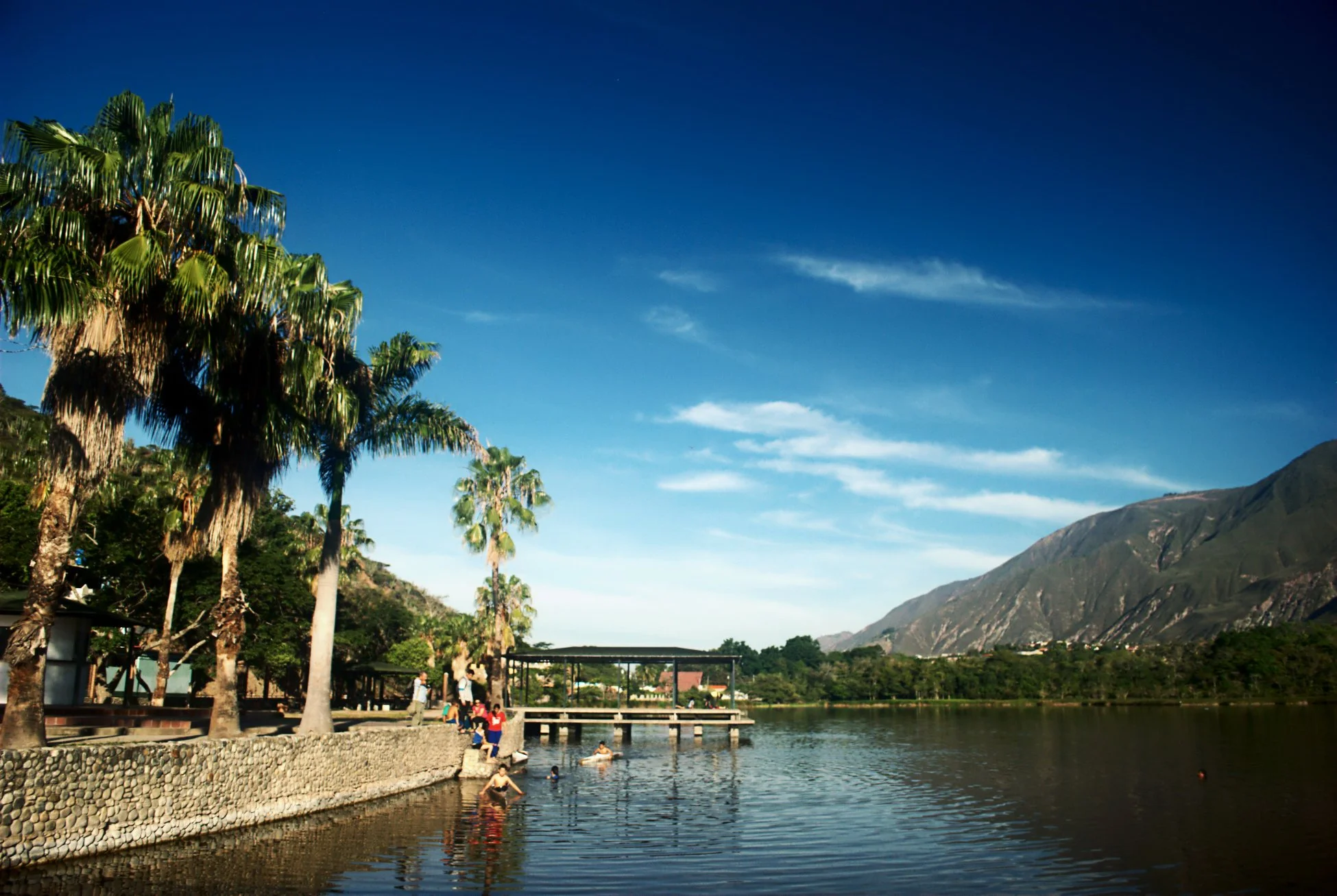
David Hernandez Aponte (2014)
We may have forgotten why such places are sacred, but we still remember some of the key messages our ancestors shared with us, guiding principles for our relationship with the land:
We must be careful with the hidden depths of our lakes, for we do not know what secrets they hold.
We must not pollute them, or we risk contaminating the very water we drink from.
We must watch out for the rain: it nourishes our land, lakes, and springs, but too much of it during a storm can destroy our houses and crops.
Indeed, the “urine” of Arco, which falls from the skies during a storm, is said to be harmful. Arco’s drizzle may, for example, give you a skin disease similar to scabies. If this happens to you, you must consult a yerbatero or curandero, the Andean equivalent of a shaman. When a storm is coming, some farmers draw a cross outside their front door as a form of protection from Arco.
Arco and Arca watch over the balance of the delicate cycle of life and death. They are reminders that we are part of a delicate ecosystem, where everything is connected and interdependent. We may have lost some of our ancestors' wisdom: there is much about ourselves and our land that we don’t fully grasp. But right now, the beating of the rain against my window reminds me of home. It reminds me that not all has been lost. We must learn to pay attention, to listen to the rain, to that sacred beat which now feels like a distant memory but which is still very much there, dormant, waiting to be found.
NOTES
Clarac de Briceño, J. 2020. “Del mito de El Dorado a los mitos y representaciones del agua y diferentes formas de su uso en los Andes de Venezuela y Colombia” Plural. Antropologías Desde América Latina Y Del Caribe (5). Retrieved from: https://asociacionlatinoamericanadeantropologia.net/revistas/index.php/plural/article/view/125
Febres Cordero, T. 2023. “La Laguna del Urao”. Retrieved from: https://eldienteroto.org/wp49/mitos-de-los-andes/
Pollak-Eltz, A. 1987. La Medicina Popular en Venezuela. Caracas: Academia Nacional de La Historia.